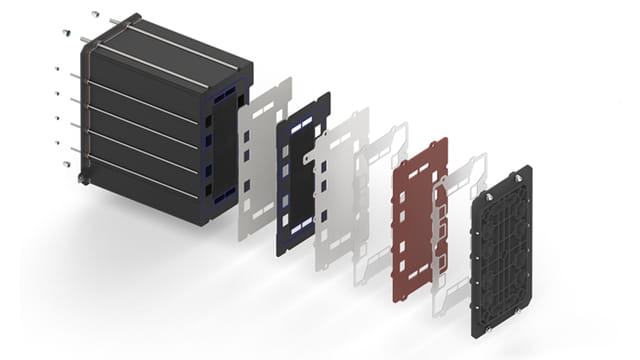
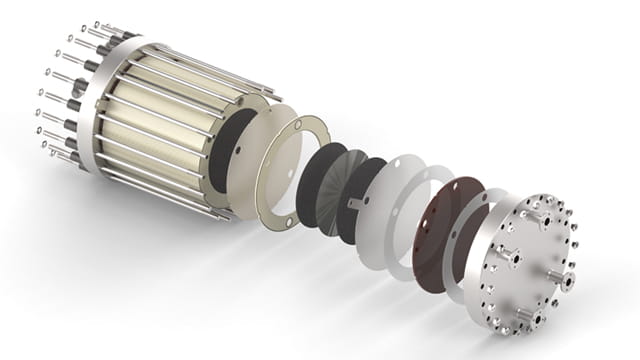
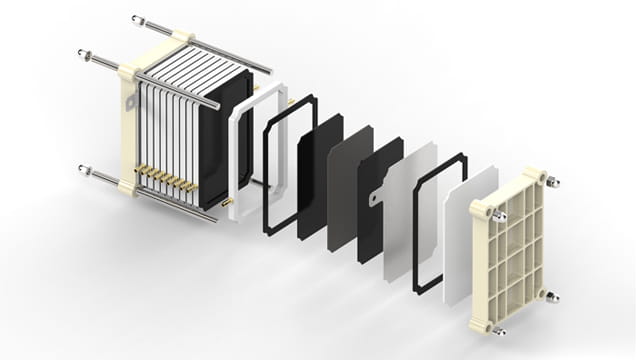
Bipolar plates perform several critical functions within a fuel cell stack: they distribute reaction gases, conduct electrical current between cells, and support thermal management. Our bipolar plates, manufactured from thermoplastic graphite-filled materials, deliver high-performance solutions for hydrogen and renewable energy applications across multiple sectors.
Our graphite bipolar plates are designed for use in:
Featuring the highest graphite content currently available on the market, our materials offer exceptionally high electrical conductivity, excellent chemical resistance, and outstanding long-term stability.
Contact us to discuss your bipolar plate requirements – our experts will be happy to advise you.


The following material data sheets with key mechanical and electrical properties are available for download:

Ensinger combines advanced material engineering with proven manufacturing expertise:
We work closely with leading research institutes such as ZSW (Center for Solar Energy and Hydrogen Research Baden-Württemberg) and ZBT (Center for Fuel Cell Technology) on reference projects. These collaborations help validate the performance and long-term stability of thermoplastic fuel cell plates under real-world operating conditions.
On this basis, we support our customers from the early concept phase through to the production-ready bipolar plate, providing solutions that are precisely tailored to each application.
Contact our experts to optimize your fuel cell system with high-performance graphite bipolar plates.

Ensinger bipolar plates are suitable for a wide range of hydrogen and energy applications. Our solutions are used in PEM fuel cell systems (PEMFC), direct methanol fuel cells (DMFC), and support industrial-scale fuel cell production. Our graphite bipolar plates are also used in electrolysis stacks and redox flow batteries, offering a high-performance alternative to metallic or thermoset-based solutions.
Whether deployed as fuel cell plates or as components of complete hydrogen fuel cell systems, our solutions contribute to efficient system operation and high long-term stability.