Bipolar plates for fuel cells

High-conductivity graphite bipolar plates with customisable flow-field designs

Bipolar plates perform several critical functions within a fuel cell stack: they distribute reaction gases, conduct electrical current between cells, and support thermal management. Our bipolar plates, manufactured from thermoplastic graphite-filled materials, deliver high-performance solutions for hydrogen and renewable energy applications across multiple sectors.

Our graphite bipolar plates are designed for use in:

  • Fuel cell stacks, including PEM fuel cell systems (PEMFC)
  • Electrolysers
  • Redox flow batteries

Featuring the highest graphite content currently available on the market, our materials offer exceptionally high electrical conductivity, excellent chemical resistance, and outstanding long-term stability.

Get in touch to discuss your bipolar plate requirements – our experts will be happy to advise you.


What are the key benefits of Ensinger fuel cell bipolar plates?

  • Very high electrical conductivity enabled by the high graphite content
  • Corrosion- and oxidation-resistant without additional coatings
  • High chemical resistance under demanding operating conditions
  • Recyclable thermoplastic matrix supporting sustainable manufacturing 
  • Customisable flow fields for both anode and cathode sides

Why Use Thermoplastic Graphite Bipolar Plates in Fuel Cells?

Electrical conductivity

Our bipolar plates offer excellent electrical conductivity. The very high graphite content – currently the highest on the market – ensures outstanding electrical performance and enables efficient current conduction within the fuel cell stack.

Corrosion resistance

As no additional coating is required, typical risks associated with coated systems such as delamination or localised corrosion are greatly reduced. This enables high long-term stability whilst also reducing manufacturing complexity.

Recyclability

A further advantage of thermoplastic bipolar plates is their recyclability. Production waste and end-of-life components can be reprocessed and returned to the material cycle, supporting more sustainable hydrogen technologies.

Temperature resistance

Temperature resistance can be tailored through material selection. Polypropylene (PP) is suitable for low-temperature PEM fuel cells operating up to approximately 90 °C, whilst polyphenylene sulphide (PPS) enables use in high-temperature PEM systems up to 230 °C. Both bipolar plate materials offer high durability under demanding operating conditions.

The following material data sheets with key mechanical and electrical properties are available for download:


Customisable Flow-Field Design for Bipolar Plates

Our manufacturing concept enables the flexible design of media-carrying structures and sealing areas. Customisable flow fields, distributor geometries, and through-holes can be integrated into the bipolar plates in a single manufacturing step.

This results in flow-field plates with custom designs on both anode and cathode sides that enable targeted optimisation of media distribution, water balance, and temperature management. This integrated design approach contributes to improved overall performance of the fuel cell stack.
  • Our bipolar plates are manufactured using a powder hot-pressing process. This approach allows the anode and cathode sides to be designed simultaneously and independently, providing a high degree of freedom in the design of functional structures. Flow fields, contact surfaces, functional zones, and cooling channels can all be customised and produced in a single manufacturing step. Subsequent surface activation further optimises electrical conductivity.
    This results in fuel cell bipolar plates that are precisely tailored to your stack requirements.
  • Our thermoplastic material system allows flexible post-processing and integration into customised systems.
    Typical downstream processes include mechanical machining, joining and bonding as well as integration into complete fuel cell stack assemblies.
  • Our manufacturing process enables graphite bipolar plates to offer greater design freedom compared to metallic alternatives. Different structures, geometries, and flow field designs can be realised with a high degree of flexibility. This allows both round and angular structures to be created, supporting optimised contact areas and improved efficiency.
  • The dimensions of our bipolar plates can be flexibly adapted to meet customer requirements. However, we are currently limited in terms of maximum size by the available pressing force and the installation space of our equipment. Within these technical constraints, we can produce a wide range of bipolar plate formats and geometries tailored to your application.

Why Opt for Graphite Bipolar Plates from Ensinger?

Ensinger combines advanced material engineering with proven manufacturing expertise:

  • Vertically integrated production – from material development and compounding to series-ready bipolar plates
  • Powder hot-pressing process enabling simultaneous, independent design of anode and cathode sides
  • Customisable flow-field designs tailored precisely to your stack requirements
  • Scalable manufacturing from prototype to series production with reproducible quality
  • Expert support throughout the entire development process

We work closely with leading research institutes such as ZSW (Centre for Solar Energy and Hydrogen Research Baden-Württemberg) and ZBT (Centre for Fuel Cell Technology) on reference projects. These collaborations help validate the performance and long-term stability of thermoplastic fuel cell plates under real-world operating conditions.

On this basis, we support our customers from the early concept phase through to the production-ready bipolar plate, providing solutions that are precisely tailored to each application.

Get in touch with our experts to optimise your fuel cell system with high-performance graphite bipolar plates.


What Are the Main Applications of Bipolar Plates?

Ensinger bipolar plates are suitable for a wide range of hydrogen and energy applications. Our solutions are used in PEM fuel cell systems (PEMFC), direct methanol fuel cells (DMFC), and support industrial-scale fuel cell production. Our graphite bipolar plates are also used in electrolysis stacks and redox flow batteries, offering a high-performance alternative to metallic or thermoset-based solutions.

Whether deployed as fuel cell plates or as components of complete hydrogen fuel cell systems, our solutions contribute to efficient system operation and high long-term stability.
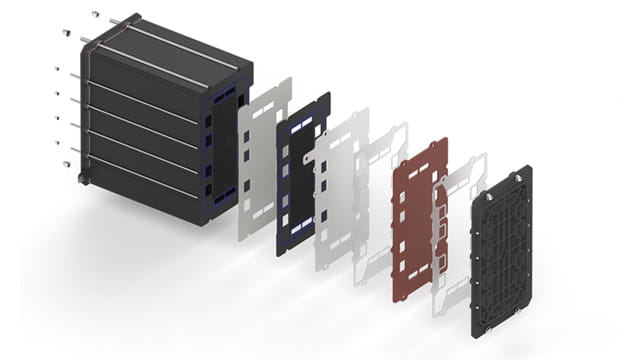
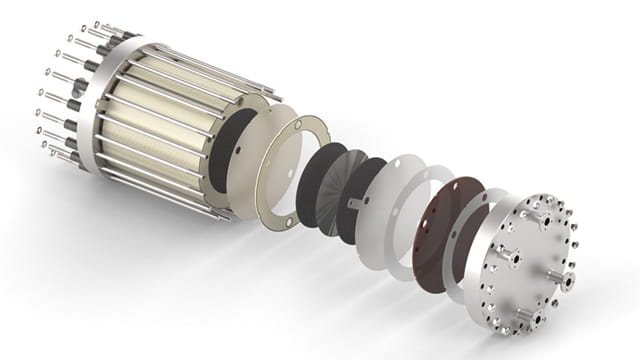
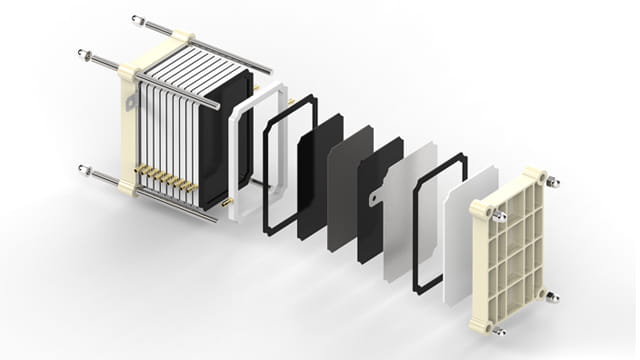
What Solutions Does Ensinger Offer for Hydrogen and Redox Flow Battery Applications?

Fuel cell stacks

Ensinger offers high-performance solutions for PEM fuel cells and additional fuel cell systems, supporting efficient and long-lasting hydrogen applications.

Electrolysis stacks

For electrolysis applications, Ensinger supplies thermoplastic solutions and parts which, thanks to their durable and corrosion-resistant materials, support reliable hydrogen production.

Redox flow batteries

Ensinger supplies robust graphite bipolar plates and solutions for redox flow batteries, supporting high-performance and sustainable energy storage systems.

Choose Ensinger as your bipolar plates manufacturer

From material development to series production, Ensinger delivers complete bipolar plate solutions tailored to your specific requirements.
Discover the future of bipolar plates with Ensinger: Benefit from our many years of experience and customised solutions for a wide range of applications. Trust in our innovative strength and reliability for optimum performance and sustainability.

Contact us today to find the right bipolar plate solution for your project. 

Frequently Asked Questions 

  • Graphite offers exceptional corrosion resistance by nature – without the need for additional coatings that could be damaged or cause extra costs. Whether in PEM fuel cells, redox flow systems or maritime environments: our bipolar plates remain stable against aggressive media such as phosphoric acid, ultrapure water or vanadium ions. This ensures a long and reliable service life for your application. 
  • Yes. Although graphite is more brittle than metal, graphite bipolar plates are sufficiently robust to withstand the mechanical demands of fuel cell operation. In PEM fuel cells, only low pressure loads of around 1 to 3 bar occur, meaning that mechanical stress is comparatively low. Under these conditions, the bipolar plates retain their dimensional stability and sealing integrity throughout their entire service life. This allows you to benefit from stable and long-lasting operation – without the risks of damage that can arise with coated metal plates.
  • Graphite is extremely temperature stable and exhibits very low thermal expansion, unlike metal plates whose coatings may crack when exposed to heat. Our graphite bipolar plates are optimised for different temperature ranges: for low-temperature fuel cells (NT-PEM) and direct methanol fuel cells (DMFC), we use polypropylene (PP); for high-temperature fuel cells (HT-PEM), we use polyphenylene sulphide (PPS). PPS can withstand temperatures of up to approximately 230 °C and ensures reliable performance even at higher operating temperatures, keeping your application safe and efficient across a wide temperature range.
  • The graphite content is the key factor determining electrical conductivity: the higher the filler content, the better the conductivity. With the highest graphite content currently available on the market, our materials achieve exceptionally high electrical conductivity comparable to metallic solutions. At the same time, the polymer matrix and filler content influence mechanical properties, temperature resistance, and processability. Our standard materials TECACOMP PP HTE PW (for low-temperature PEM up to 90 °C) and TECACOMP PPS HTE PW (for high-temperature PEM up to 230 °C) are optimised for an ideal property profile.

    Contact us – we'll be happy to advise you on the right material solution for your application.

  • Thermosetting plates are cast in moulds where they cure permanently. They are not recyclable and result in higher waste, as offcuts or sprues cannot be reused. Thermoplastic bipolar plates, on the other hand, are recyclable and therefore have a lower carbon footprint. Scrap material can be remelted and reprocessed. Chemically and mechanically, both types of material are comparable.
  • Metallic bipolar plates are very robust, offer high electrical conductivity, and are primarily used in mobile fuel cell systems, such as in vehicles or aerospace applications. However, to be corrosion-resistant, they require complex coating with expensive raw materials. These coatings and the tooling technology required significantly increase costs, and potential corrosion damage can further reduce service life.

    Graphitic bipolar plates, on the other hand, are naturally corrosion-resistant, require no additional coating, and offer greater design freedom. They excel through their chemical stability and are preferentially used in stationary or industrial applications. The graphite content is also the key factor determining electrical conductivity: the higher the filler content, the better the conductivity. With the highest graphite content currently available on the market, our materials achieve exceptionally high electrical conductivity comparable to metallic solutions.  
  • Demand is growing rapidly, particularly in the heavy-duty, stationary power supply, and maritime sectors. Those who opt for graphite bipolar plates today benefit from a future-proof solution in an expanding market.
  • At Ensinger, we work with established suppliers and ensure stable material availability. Through our integrated manufacturing approach – from raw material to the finished plate – we guarantee consistently high quality and delivery reliability.