
Ball bearings for satellite deployment systems
Communications, meteorology and Earth observation
These deployment systems are among the key mechanical assemblies of modern satellites. Systems such as Large Deployable Antennas (LDA) and Large Deployable Reflectors (LDR(S)) with the Antenna Deployment and Base Mechanism can reach diameters of more than ten metres in orbit. To ensure that such large-scale structures can be deployed reliably, high-precision and durable bearing solutions are required that remain functional even under the extreme conditions of space.

Ensinger Plastics in adjustable antenna reflectors
Functional requirements for bearing solutions in orbit
At the same time, the bearings must maintain high precision and low friction coefficients over millions of movement cycles. Even a single jerky start or stutter can jeopardise the controlled deployment of the antennas and reflectors. The bearing cage must therefore be made from a suitable material that extends the bearing’s service life by selflubrication .
Furthermore, the operating conditions demand bearing designs that offer high strength with low weight and retain their dimensional stability and accuracy even under thermal stress.
Material development in the ESA SLPMC2 project – TECASINT 8591
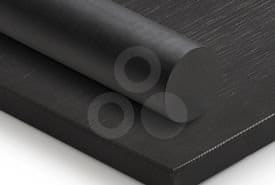
To meet the requirements and reduce reliance on overseas suppliers, the ‘Self-Lubricating Polymer Matrix Composites (SLPMC2)’ project was launched. As part of this project, Ensinger Sintimid, in collaboration with the European Space Agency (ESA) and Aerospace & Advanced Composites (AAC), developed the new tribological material type TECASINT 8591.
This self-lubricating containing special lubricating additives and fillers, meets high tribological requirements such as low friction and wear at slow sliding speeds without stick-slip effects. The lubricant is carried off the TECASINT 8591 cage material by the sliding of the balls and transferred to the raceway of the ball bearing, thereby creating a uniform and lasting lubricating effect. Even at cryogenic temperatures and under vacuum, this material exhibits excellent sliding properties and is therefore ideally suited for use as bearing material in space.
The Ensinger material is a suitable and ESA approved alternative to the well-known the PGM-HT.
In addition to its tribological properties, the material meets the outgassing limits according to ECSS Q70-02 and exhibits low post-shrinkage.
Constant torque and reliable friction behavior
Bearing test: TECASINT 8591 versus PGM-HT
 Ball bearing cage with an outer diameter of 40 mm
TECASINT 8591
Low friction & wear tested over more than 20 million revolutions
Approved by the ESA


Typical properties
- Highly Selflubricating
- Low coefficient of friction
- No stick-slip effects
- Less wear and friction
- Low bearing torque
- Tight tolerances and no shrinkage
- Low outgassing according to ECSS Q 70-02
- Coefficient of thermal expansion CLTE comparable to PGM-HT (previous material)